

Faculty of Media System and Mass Communication
Address: 49045, Dnipro, 13 Naukovà Street, Academic Building No. 9, Floors 5–6, Dean’s Office, Room 505
Dean’s Office phone numbers: +38 (096) 238-68-97
Dean’s Office E-mail: fszmk@365.dnu.edu.ua
Faculty Website: http://fszmk.dnu.dp.ua/
Faculty Instagram: https://instagram.com/fszmk.dnu_official
Faculty Facebook: https://www.facebook.com/FszmkDNU
Faculty Telegram Channel: https://t.me/press_fszmk_dnu
Faculty YouTube Channel: https://www.youtube.com/watch?v=jRVDAcTmsYQ
Faculty TikTok: https://www.tiktok.com/@fszmk
Dean’s Office phone numbers: +38 (096) 238-68-97
Dean’s Office E-mail: fszmk@365.dnu.edu.ua
Faculty Website: http://fszmk.dnu.dp.ua/
Faculty Instagram: https://instagram.com/fszmk.dnu_official
Faculty Facebook: https://www.facebook.com/FszmkDNU
Faculty Telegram Channel: https://t.me/press_fszmk_dnu
Faculty YouTube Channel: https://www.youtube.com/watch?v=jRVDAcTmsYQ
Faculty TikTok: https://www.tiktok.com/@fszmk
Educational Activities
The Faculty of Systems and Means of Mass Communication provides education at three levels of higher education — the first (Bachelor’s), second (Master’s), and third (PhD) levels — in two fields of study: C7 Journalism and B13 Library, Information and Archival Studies.
Educational Programs
First (Bachelor’s) Level:
C7 Journalism
● Educational Program “Journalism”
● Educational Program “Advertising and Public Relations”
B13 Library, Information and Archival Studies
● Educational Program Program “Digital Media”
Second (Master’s) Level:
C7 Journalism
● Educational Program “Media Communications”
● Educational Program “Advertising and Public Relations”
B13 Library, Information and Archival Studies
● Educational Program Program Information Activity Management
The Faculty also offers Third (PhD) educational level within the specialty C7 Journalism.
Practical Experience and Academic Development of Students
Starting from the second year of study, students undertake academic and professional internships at leading media organizations, including television and radio companies, print and online media outlets, information and advertising agencies, press offices, publishing houses, libraries, digital archives, and other specialized institutions. The Faculty actively supports the employment of its graduates in regional and national media organizations.
During their studies, students develop professional portfolios that include media projects, publications in mass media, information and advertising campaigns, case studies, and startups. These portfolios form the basis for the preparation of Bachelor’s qualification theses and contribute significantly to students’ professional development.
Students’ academic and research activities begin in the first year of study. For those interested in mass communication theory, contemporary communication studies, and academic research, student research groups operate within each educational program. Our students actively participate in regional, national, and international academic and research conferences, scientific competitions, and student academic Olympiads, and also publish articles in peer-reviewed academic journals.
During their studies, students develop professional portfolios that include media projects, publications in mass media, information and advertising campaigns, case studies, and startups. These portfolios form the basis for the preparation of Bachelor’s qualification theses and contribute significantly to students’ professional development.
Students’ academic and research activities begin in the first year of study. For those interested in mass communication theory, contemporary communication studies, and academic research, student research groups operate within each educational program. Our students actively participate in regional, national, and international academic and research conferences, scientific competitions, and student academic Olympiads, and also publish articles in peer-reviewed academic journals.
PhD Studies: A Path to an Academic Career

We invite applicants who aspire to pursue a career in academia to enroll in PhD studies. The Educational and Research Program Journalism within the specialty C7 Journalism for the third (educational and research) level of higher education was launched in 2016. The program has been developed in line with current media environment demands and employer expectations and fully complies with applicable national legislation. It is regularly updated and modernized in response to contemporary challenges in media and communication research.
The academic staff involved in the program meet all licensing requirements, have research publications indexed in international databases such as Scopus and Web of Science, continuously improve their professional qualifications, and actively engage in media research.
PhD students of the Faculty participate in academic conferences, publish their research findings in leading scholarly journals, and conduct research on relevant topics aligned with the strategic development priorities of the departments.
The academic staff involved in the program meet all licensing requirements, have research publications indexed in international databases such as Scopus and Web of Science, continuously improve their professional qualifications, and actively engage in media research.
PhD students of the Faculty participate in academic conferences, publish their research findings in leading scholarly journals, and conduct research on relevant topics aligned with the strategic development priorities of the departments.
Faculty Administration
Dean of the Faculty – Oksana Kyrylova, PhD in Philology, Associate Professor.
Vice Dean for Academic Affairs – Alla Mykhailova, PhD in Philology, Associate Professor.
Vice Dean for Research – Oksana Hudoshnyk, PhD in Philology, Associate Professor.
Vice Dean for International Cooperation and Student Affairs – Yuliia Harkavenko, PhD in Social Communications.
Vice Dean for Student Affairs – Andrii Gusev, PhD in Social Communications, Associate Professor.
Structural Units of the Faculty
• Department of Mass and International Communication
• Department of Advertising and Public Relations
• Department of Media Communications and Communication Technologies
“Modern Media” Laboratory

Students of the Faculty continuously master new technologies and explore innovations in the contemporary media environment. Classes are conducted with the active use of the facilities of the “Modern Media” Teaching Laboratory, which provides practical training and hands-on experience with modern media tools and technologies.
The archive of student projects is constantly expanding with new works. Selected projects can be viewed on the Faculty website: http://fszmk.dnu.dp.ua/media_projects.html
Convergent Newsroom “Honchar Info”
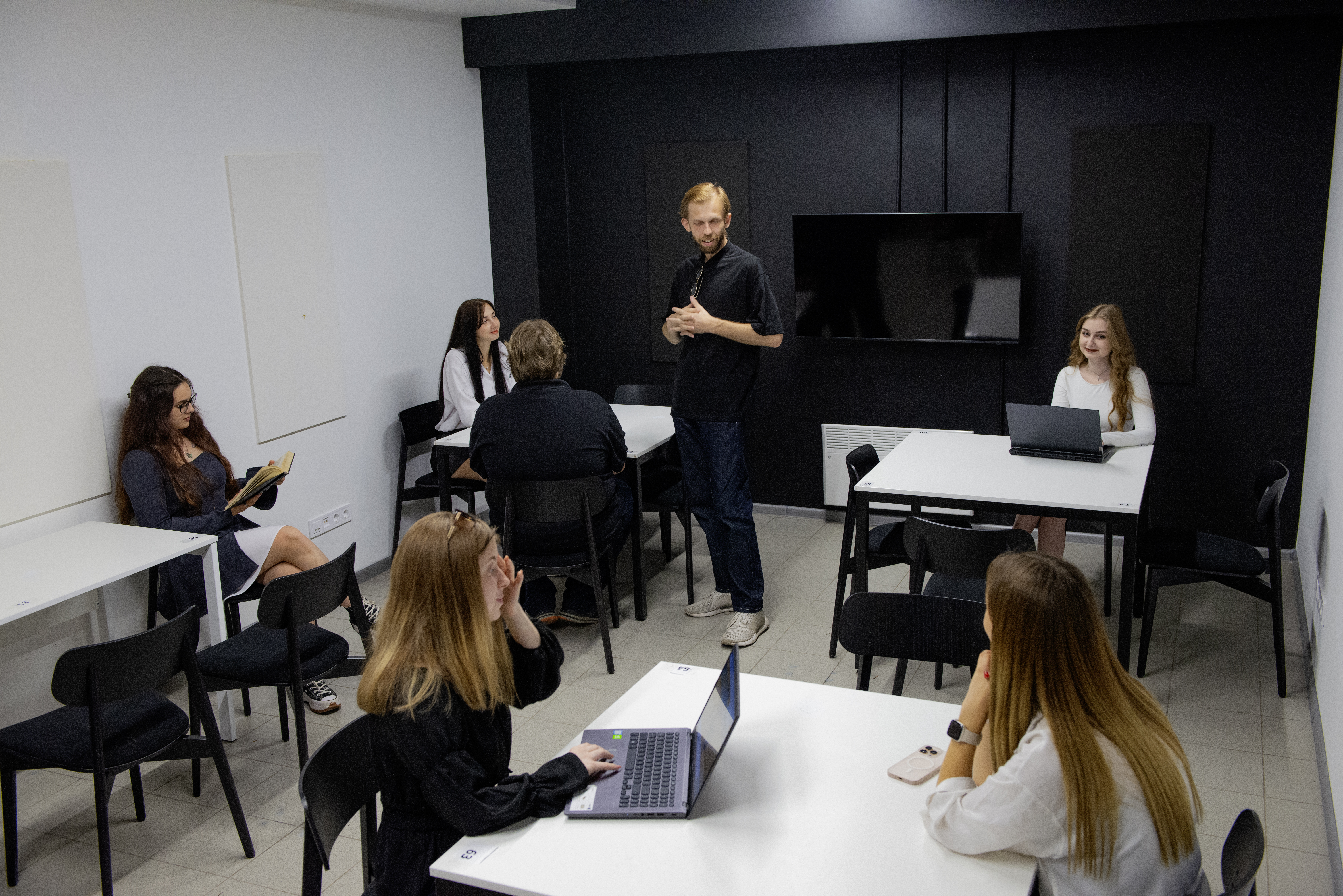
Honchar Info is a media project of the large and friendly community, created by students for students. It covers a wide range of interests, highlights events in university and faculty life, and operates across all modern media formats:
● online publications
● printed magazine issues
● podcasts
● vlogs
● social media platforms
For Dnipro National University students, Honchar Info is primarily an educational media project that enables future journalists to showcase their talents and develop key professional skills under the guidance of experienced faculty members.
Each issue is produced with special care and dedication. A full team works on the content: the editorial board defines the theme of the issue; journalists collect information and write articles; photographers create exclusive visual materials; and designers are responsible for layout and visual design. Throughout the production process, students master all stages of newspaper and magazine creation — from information gathering to final publication.
Multimedia journalism skills are developed through work with infographics, photo galleries, podcasts, video reports, media games, quizzes, and immersive publications.
Our issues reflect achievements, challenges, creative publications, and valuable learning experiences, as we continuously strive for improvement. All materials are available on our website: https://fszmk.dnu.dp.ua/honchar_info.html.
The Honchar Info editorial team actively collaborates with students of grades 9–11 who aspire to become journalists. If you have interesting materials, please send them to: fszmk@365.dnu.edu.ua, and they will be carefully reviewed.
Invitation to High School Students
The Faculty of Media System and Mass Communication invites students of grades 9–11 to join educational and creative projects aimed at developing skills in journalism, communications, and media production.
Multimedia Editorial Office “Honchar Info”
High school students interested in journalism, blogging, podcasting, or media content creation are welcome to participate in the activities of the Honchar Info multimedia editorial office. The editorial team accepts original submissions, including:
● articles, features, essays, poems, comics, and crosswords for publication in print and digital editions;
● videos and podcasts for distribution via the Faculty’s official digital platforms.
To participate, please submit your materials to fszmk@365.dnu.edu.ua.
● online publications
● printed magazine issues
● podcasts
● vlogs
● social media platforms
For Dnipro National University students, Honchar Info is primarily an educational media project that enables future journalists to showcase their talents and develop key professional skills under the guidance of experienced faculty members.
Each issue is produced with special care and dedication. A full team works on the content: the editorial board defines the theme of the issue; journalists collect information and write articles; photographers create exclusive visual materials; and designers are responsible for layout and visual design. Throughout the production process, students master all stages of newspaper and magazine creation — from information gathering to final publication.
Multimedia journalism skills are developed through work with infographics, photo galleries, podcasts, video reports, media games, quizzes, and immersive publications.
Our issues reflect achievements, challenges, creative publications, and valuable learning experiences, as we continuously strive for improvement. All materials are available on our website: https://fszmk.dnu.dp.ua/honchar_info.html.
The Honchar Info editorial team actively collaborates with students of grades 9–11 who aspire to become journalists. If you have interesting materials, please send them to: fszmk@365.dnu.edu.ua, and they will be carefully reviewed.
Invitation to High School Students
The Faculty of Media System and Mass Communication invites students of grades 9–11 to join educational and creative projects aimed at developing skills in journalism, communications, and media production.
Multimedia Editorial Office “Honchar Info”
High school students interested in journalism, blogging, podcasting, or media content creation are welcome to participate in the activities of the Honchar Info multimedia editorial office. The editorial team accepts original submissions, including:
● articles, features, essays, poems, comics, and crosswords for publication in print and digital editions;
● videos and podcasts for distribution via the Faculty’s official digital platforms.
To participate, please submit your materials to fszmk@365.dnu.edu.ua.
Media School “Open Space”

The Faculty hosts the “Open Space” Media School, which operates free of charge throughout the academic year. The program offers high school students an opportunity to deepen their knowledge of the media field, acquire practical content creation skills, and receive guidance from faculty members and professional journalists.
Media School participants:
● become familiar with the fundamentals of journalism, advertising, and public relations;
● learn to work with text, photo, video, and audio content;
● take part in workshops and master classes led by leading industry professionals.
How to join:
For detailed information on participation in the Faculty’s projects, please contact us via email at fszmk@365.dnu.edu.ua.
Media School participants:
● become familiar with the fundamentals of journalism, advertising, and public relations;
● learn to work with text, photo, video, and audio content;
● take part in workshops and master classes led by leading industry professionals.
How to join:
For detailed information on participation in the Faculty’s projects, please contact us via email at fszmk@365.dnu.edu.ua.
Research and Scientific-Technical Activities
The Faculty employs 2 Doctors of Sciences and 16 PhD holders. Research activities are carried out within departmental applied research projects, encompassing studies and experimental developments in the fields of contemporary communication studies, journalism studies, information activity, and media technologies.
The results of the research are disseminated and validated through:
● scholarly monographs;
● the peer-reviewed academic journal Communications and Communicative Technologies, which is included in the List of Professional Scholarly Journals of Ukraine (Category B);
● Ukrainian and international academic journals;
● international and national academic and applied research conferences, in which the Faculty’s academic staff are regular participants.
Active cooperation with the Dnipro department of the Junior Academy of Sciences of Ukraine (Journalism Section) has intensified work with prospective applicants and diversified its formats. Faculty members move beyond traditional lecture-based approaches by offering presentation-based formats, interactive practical assignments, and sustained online communication with members of the section.
Student Life
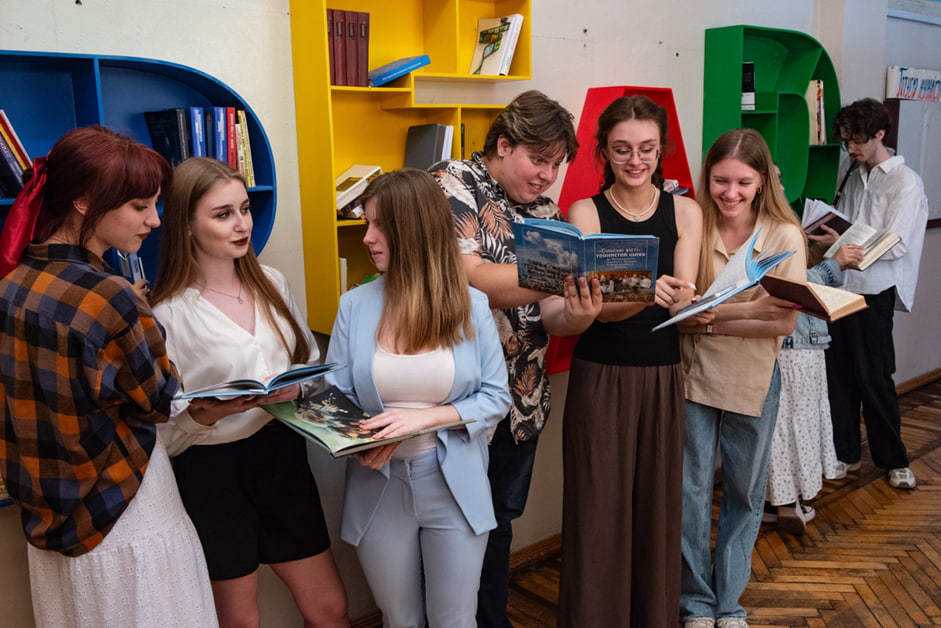
University life is not only about studying — it is also about years filled with experiences that stay with you forever. After graduation, not everyone will remember every course, but everyone remembers their first initiation ceremony. Even in challenging times, our Faculty strives to create these unforgettable moments for its students.
Each year, students come together at large-scale events such as the DNU Picnic and DNU Fest, which foster a strong sense of community and excitement. Celebrations of Valentine’s Day, Halloween, New Year, Christmas, and Student’s Day provide great opportunities to spend time with friends, meet students from other faculties, and truly experience the university spirit. The Student Council is constantly working to make student life engaging and vibrant.
And what about practical experience? Even during periods of remote learning caused by the war, the Faculty offers a mixed learning format. Students attend elective classes where, starting from the first year, they take their first steps in media practice, explore the realities of modern journalism, and interact with practitioner-lecturers. No boring lectures, but an open, comfortable atmosphere with tea, snacks, hands-on practice, laughter, and even board games at the end of classes.
Throughout the academic year, freshmen have the opportunity to study at the media school, collaborate with the Vesnianka Film Center, and visit leading media organizations in Dnipro. And this is only the beginning. From the second year onward, future media professionals work in the Honchar Info convergent newsroom, create their own media projects, and build personal portfolios.
And there is more! Have you seen photos of our students in Poland, Italy, Spain, or Turkey? Every year, the Faculty sends students on academic mobility programs to leading universities around the world. This is a unique opportunity to spend a semester abroad, gain new academic and cultural experience, and immerse yourself in a different environment. Most importantly, participation in these programs is completely free of charge. The main requirements are active student engagement and strong academic performance. If you meet these criteria, you will certainly be selected — and the Faculty’s academic staff will always support you and help you take the first step toward making this dream a reality.
Each year, students come together at large-scale events such as the DNU Picnic and DNU Fest, which foster a strong sense of community and excitement. Celebrations of Valentine’s Day, Halloween, New Year, Christmas, and Student’s Day provide great opportunities to spend time with friends, meet students from other faculties, and truly experience the university spirit. The Student Council is constantly working to make student life engaging and vibrant.
And what about practical experience? Even during periods of remote learning caused by the war, the Faculty offers a mixed learning format. Students attend elective classes where, starting from the first year, they take their first steps in media practice, explore the realities of modern journalism, and interact with practitioner-lecturers. No boring lectures, but an open, comfortable atmosphere with tea, snacks, hands-on practice, laughter, and even board games at the end of classes.
Throughout the academic year, freshmen have the opportunity to study at the media school, collaborate with the Vesnianka Film Center, and visit leading media organizations in Dnipro. And this is only the beginning. From the second year onward, future media professionals work in the Honchar Info convergent newsroom, create their own media projects, and build personal portfolios.
And there is more! Have you seen photos of our students in Poland, Italy, Spain, or Turkey? Every year, the Faculty sends students on academic mobility programs to leading universities around the world. This is a unique opportunity to spend a semester abroad, gain new academic and cultural experience, and immerse yourself in a different environment. Most importantly, participation in these programs is completely free of charge. The main requirements are active student engagement and strong academic performance. If you meet these criteria, you will certainly be selected — and the Faculty’s academic staff will always support you and help you take the first step toward making this dream a reality.
The Student Council of the Faculty of Media System and Mass Communication warmly welcomes every new student. And if you are still a prospective applicant, you are also invited to visit the media school, meet faculty members, students, and the administration, and ask all your questions in person. Join us, learn more about journalism, and become part of our academic community!
Historical Overview
The Faculty of Media System and Mass Communication of Oles Honchar Dnipro National University has more than 30 years of experience in training professionals in the fields of journalism, media, advertising, and communications.
In 1991, a decision was made to open the Journalism specialty. By order of the Rector, the establishment of the Department of Journalism was entrusted to Volodymyr Demchenko, Doctor of Sciences in Philology, Professor, and Honored Journalist of Ukraine. In the same year, the first cohort of students was admitted, and in 1995 the Faculty celebrated its first graduation of journalists.
In 1996, the International Information specialty was launched to prepare professionals for work in the global information environment. Due to the need for in-depth foreign language training, the Department of Philological and Cultural Training of Journalists was established.
The expansion of educational opportunities contributed to the formation of a new faculty — the The Faculty of Media System and Mass Communication. To ensure professional training in media communications, the Department of Linguistic and Area Studies for Journalists was created.
In response to the rapid development of communication technologies and marketing communications, the Faculty began training specialists in Organization Management in 1997. In 1998, the Department of Media Management and Advertising Organization was established (later renamed the Department of Media Management, Advertising, and Public Relations). In 2007, the specialty was transformed into Advertising and Public Relations, which became part of the field Journalism and Information.
In 2002, the Faculty opened the Publishing and Editing specialty, responding to societal demand for professionals in the book publishing industry.
In 2008, the Faculty acquired a modern educational media laboratory, and in 2012 it launched Master’s degree programs in Advertising and Public Relations and Publishing and Editing.
Given the dynamic development of digital media, a new educational program, Digital Media (specialty B13 Library, Information and Archival Studies), was introduced in the 2022/2023 academic year. This led to structural changes, including the establishment of the Department of Media Communications and Communication Technologies. Since 2024, the Faculty has also offered Master’s level training in the B13 specialty through the program Informational Management.
In 1991, a decision was made to open the Journalism specialty. By order of the Rector, the establishment of the Department of Journalism was entrusted to Volodymyr Demchenko, Doctor of Sciences in Philology, Professor, and Honored Journalist of Ukraine. In the same year, the first cohort of students was admitted, and in 1995 the Faculty celebrated its first graduation of journalists.
In 1996, the International Information specialty was launched to prepare professionals for work in the global information environment. Due to the need for in-depth foreign language training, the Department of Philological and Cultural Training of Journalists was established.
The expansion of educational opportunities contributed to the formation of a new faculty — the The Faculty of Media System and Mass Communication. To ensure professional training in media communications, the Department of Linguistic and Area Studies for Journalists was created.
In response to the rapid development of communication technologies and marketing communications, the Faculty began training specialists in Organization Management in 1997. In 1998, the Department of Media Management and Advertising Organization was established (later renamed the Department of Media Management, Advertising, and Public Relations). In 2007, the specialty was transformed into Advertising and Public Relations, which became part of the field Journalism and Information.
In 2002, the Faculty opened the Publishing and Editing specialty, responding to societal demand for professionals in the book publishing industry.
In 2008, the Faculty acquired a modern educational media laboratory, and in 2012 it launched Master’s degree programs in Advertising and Public Relations and Publishing and Editing.
Given the dynamic development of digital media, a new educational program, Digital Media (specialty B13 Library, Information and Archival Studies), was introduced in the 2022/2023 academic year. This led to structural changes, including the establishment of the Department of Media Communications and Communication Technologies. Since 2024, the Faculty has also offered Master’s level training in the B13 specialty through the program Informational Management.
Today, the Faculty comprises three departments, the Media Teaching Laboratory, a convergent newsroom, its own library, and a media archive.
The Faculty continues to develop dynamically, preparing competitive professionals capable of working effectively in the contemporary media environment.
The Faculty continues to develop dynamically, preparing competitive professionals capable of working effectively in the contemporary media environment.